11 May 2013

Cleanskin


Cleanskin a Fine, Contemporary Thriller
By Kristin Battestella


It took me a few days to watch this 2012 British thriller thanks to its unfortunate arrival the same week as the terrorist events in Boston. However, the taught, gritty realism here makes for a solid modern espionage film full of spy intrigue suspense.

Secret Service agent Ewan (Sean Bean) survives a terrorist attack and the assassination of his charge, and his superior Charlotte (Charlotte Rampling) sends him on an unofficial covert mission to find the cell responsible, as Semtex explosives stolen during the attack must be retrieved. Ewan and his new partner Mark (Tom Burke) seek the perpetrator Ash (Abhin Galeya) – a young English born radical and student – hoping to catch him before more threats and attacks endanger London. Unfortunately, the deeper Ewan digs, the more he sinks into the corrupt secret agent game, and all the while, Ash gets closer to his next target.  


Writer and director Hadi Hajaig (Puritan) opens Cleanskin with a weird sex scene and intercut news coverage. It’s a bit jarring compared to the often meaningless in your face action introductions we expect from heavy films today, but this smart approach builds intrigue and allows time for all the pieces to unfold. The violence, however, is intense once it happens – realistic, frightening, fast, and shocking. Scenes feel longer and deeper because of the tense attention to detail, and the complex technical talk, ordinance details, and political information demands undivided viewing attention. Not all the information is given to the audience at once – which can be a little confusing, since we are often too accustom to having easy answers in contemporary films – and some action scenes, tortures, and beat downs will be tough to watch, indeed.  Cleanskin places its intelligence above generic action thrills a minute. However, the impression that is an all out action picture rather than a European political thriller probably hurt its draw stateside, and the flashbacks showing Ash’s history and the rise of his terror cell are mishandled. These critical character developments should have begun the film or been intercut with the opening scenes. It’s simply odd at best and bad filmmaking at worst to stop your forward moving action and tell the viewers what we should already know. It’s heavy, not often seen stuff, but this parallel backward perspective is not as interesting as the more familiar secret agent pursuit plots. Pacing drags in the middle as time is unevenly spent in one storyline or the other. There’s material enough for more – two separate films, perhaps – but the mismatched focus hampers both plotlines. Fortunately, the converging plots do come together for an intense, excellent finale.

Rather than some of these blink and you miss him crappy films, I’m so glad to see Game of Thrones star and BAFTA nominee Sean Bean as a man of action again with a complex, mature character. He looks good in contemporary leather and tight sweaters, and the short hair/scruffy beard combination fits the undercover desperation. Though lethal, Ewan makes mistakes. He has a past and doesn’t want things to get ugly, but he’ll do the heavy nonetheless. He doesn’t speak much and is tough to hear at times, but he is damn effective at scaring people into giving him what he wants.  Ewan’s professional, but gritty, grey, and dirty in his pursuit of these terrorists. When does one cross the line between defending his country and becoming exactly like his prey? Bean is so seamless in the role that one can almost believe he’s this badass in real life when he’s not making movies! Some viewers might presume he is older and past his glorious Sharpe days, but the soft-spoken, unassuming, off the deep end secret agent seems like the part he was born to play. While I like Liam Neeson and his Taken glory and Zeus love in Clash of the Titans, I don’t understand why Bean is continually relegated to being that other Zeus for 5 minutes in dismissed films like Percy Jackson or the barely there King in Mirror Mirror. You don’t need to take those roles, Sean! Bean should definitely be doing this type of quiet, thoughtful, action thriller much more. Those who enjoy Cleanskin should also see the 1999 television production Extremely Dangerous, and his latest pilot Legends – also a spy caper – has been greenlit by TNT. Yes!


Charlotte Rampling (The Verdict, Stardust Memories, Swimming Pool) also brings some wonderfully strong femininity to Cleanskin as a sophisticated spy executive. Her usual excellence and grace is business suit imposing instead of Hollywood pretentious, and it’s clear that this handler has her own motivations to further stir the political plots. Tom Burke (Casanova) as Ewan’s rookie partner makes for an interesting companion to Bean as well. Though playful with an infant daughter, he has perfect, deadly aim. Cleanskin does have some brief TnA and sex scenes, but prostitute Shivani Ghai (Bride and Prejudice) is not exploited onscreen as is so often the case in action films. We don’t even see her in lingerie, much less naked or kinky; but for better or worse, the character is used smartly in the terror twists and plots. The ensemble does a fine job in making the audience question who everyone is, if we trust them, and who the villains really are.  Abhin Galeya (Wimbledon) looks the part as main antagonist Ash, but Cleanskin is slow to show him as more than what we unfortunately now perceive as the standard Middle Eastern terrorist – again, his flashbacks should have come much sooner to elaborate and build sympathy. Are we really to believe Ash does all this over some bloke jealousy, the wrong English girl, and the charismatic words of a radical leader? This past tense development comes across as too easy, a typical, not heartfelt depiction, and at times, makes light of Muslim extremists and any brainwashing possibilities. Is Ash a deadly, created trigger or just an angry boy? Can one be both? Maybe, but Cleanskin’s presentation makes this point somewhat wishy-washy. For whom are we supposed to root anyway? Perhaps that is the questioning goal of the film. 


Cleanskin looks the London quality, too. All the UK locations are grand, and the picture is bright and crisp. Us across the pond are able to feel the city realism and see everything – not like the usual dark color gradients and flashy, choppy editing. Instead of being over bearing and loud or creating the need for constant volume adjustment, there are just enough themes and motifs in the pleasing, but tense underscoring as well.  It seems weird to say, but the violence here is also good – shockingly realistic designs, explosions, and action sequences rather than just gore for gore’s sake. Television footage and media coverage are spliced seamlessly into Cleanskin, creating a quite telling and timely aspect. It’s tough to watch the first time due to its subject matter, but Cleanskin really demands multiple viewings to completely notice all the onscreen media and news crawls – this picture has subtext, indeed. Some of the thoroughly British statements might be missed by American audiences, however, and subtitles are necessary for some soft dialogue. The blu-ray, of course, looks great, and there is a half hour behind the scenes feature with lots of Sean Bean and special effects secrets.


Those who don’t like action, gun violence, and terrorism intensity will find Cleanskin difficult, yes. However, don’t let any misrepresentation trying to make this more thought provoking political thriller fit into the American bang ‘em up formulaic action designs. I don’t understand why Cleanskin hasn’t garnered more attention, as it definitely fills the void left by the long running British series MI-5.  Truly, Cleanskin replaces the weaker final seasons of the show, when the taught, gripping, and relevant drama ended as a knockoff of 24. I do fear this picture might be offensive to Muslims in some of its extreme depictions, yet I’m glad films are attempting to shed light on the often misconstrued face of terrorism. Bean fans will certainly love to see him in this meaty if somewhat uneven and slightly muddled caper. Despite the flashback flaws hampering its presentation and the message it is trying to send, Cleanskin is a gripping, must see contemporary thriller.

07 May 2013

Enterprise Season 2


Enterprise Season 2 is the Low Point of the Series 
By Kristin Battestella


Understandably, Enterprise had growing pains relating to its prequel approach in its debut season.  However, after a lot of promise in its first year, the second season of the last Star Trek spin off sinks to new lows and most likely put the final nail in the series’ coffin- two years in advance.

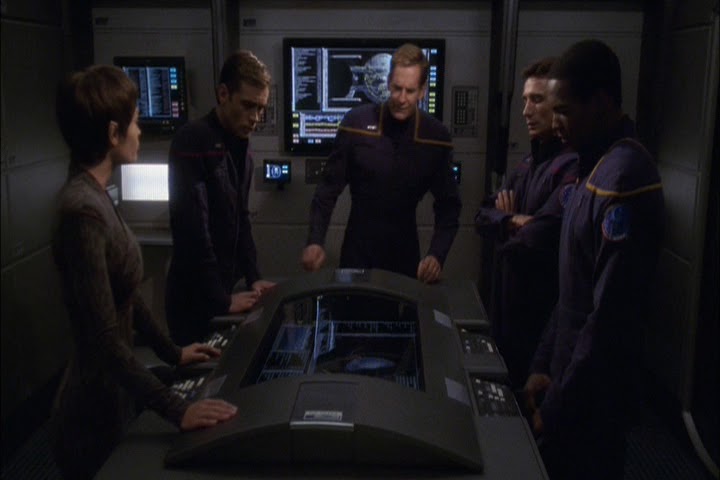
Captain Jonathan Archer (Scott Bakula), his Chief Engineer Trip Tucker (Connor Trinneer), and Vulcan Science Officer T’Pol (Jolene Blalock) battle familiar enemies and unseen foes as the NX-01 Enterprise – Starfleet’s first Warp 5 vessel – continues its exploration of nearby star systems.  Past transgressions, galactic intrigue, and pre-industrial first contact mistakes also make life difficult for Doctor Phlox (John Billingsley) and Lieutenant Malcolm Reed (Dominic Keating) as Enterprise is used in Temporal Cold War tricks and betrayals – which eventually create devastating consequences for Earth.


The “Shockwave Part 2” cliffhanger resolution starts Enterprise’s Year 2 off great. The offbeat “Carbon Creek,” hints of Romulan tensions in “Minefield,” and a touch of spooky in “Dead Stop” all build solid Star Trek mood and science fiction atmosphere. These are unique episodes with prequel pieces that no other Trek series could have done, and each has the viewer returning week after week.  “The Seventh” is a worthy T’Pol espionage adventure, and “The Communicator” shows Trek audiences how pre-industrial contact can go horribly awry. Now that we know the crew a little better, it’s also fun to see them go nutty in “Singularity” or camp out in “The Catwalk.”  Jeffrey Combs returns as the Andorian Shran in “Cease Fire,” and “Future Tense” is a strong time episode that remains smartly TOS instead of Temporal Cold War. “The Breach” also has some excellent science fiction debates between Archer and Dr. Phlox, and these shows are a great example of how Enterprise should always be. This crew toes the no Prime Directive line, and sometimes the humans are the jerks of the budding galactic community, yes. They often get into trouble by helping or not helping alien friends and neighbors. Unlike some previous episodic Trek that kept things nice, easy, and tidy, however, consequences can linger on Enterprise, and “Cogenitor” is an awesome example of SF mistakes and misunderstandings that cannot be taken back.

Thus far, it sounds like Enterprise’s second season is nothing but glory, I know.  Unfortunately, a batch of bad episodes sent the show’s viewership into a tailspin from which it never recovered.  After the notoriously Freudian forced “A Night in Sickbay,” Enterprise drove itself further down with the rehashedly bad “Precious Cargo” and the typical save the frontier town “Marauders.” “Vanishing Point” might not be a bad show in and of itself, but the Hoshi Sato (Linda Park) dreamt it all crux is enough to anger audiences into never watching again. Likewise, “Dawn” is a complete Enemy Mine joke, and the serious episodes can’t gain any momentum thanks to unacceptable clunkers like this. Although “The Crossing” and “Horizon” are hokey and “Stigma” is obvious in its AIDS allegory, it’s tough to take even the half decent amid so much bad.  “Canamar,” “Judgment,” and “Bounty” also suffer from statistical retreads, for how many times can Archer be abducted or kidnapped, hijacked or imprisoned, or taken hostage and committed in one season? We seen the nods to Star Trek VI, love the Klingons, Tellarites, and faux pon farr. Sadly, these are all plots we’ve seen too much already, and its all the more infuriating here because Enterprise should be doing so much more with its pre-Kirk designs.


“Regeneration” encapsulates this very conundrum. On its own, this is a fine episode, complete with superb X-Files spooky and scares, action plotting, and big consequences. Were this simply a rogue horror episode, no one would object to its appearance on Enterprise. Unfortunately, longtime Trek viewers will groan at the officially unofficial appearance of the Borg, 24th century tech babble, and the Delta Quadrant paradoxes created here. Is it a good show? Yes. Does it belong on Enterprise? No. “First Flight,” by contrast, shows us Archer’s motivations in the early Warp program and provides a lovely guest performance by Keith Carradine.  This bumbling San Fran base and competitive space race storyline makes one wonder why Enterprise didn’t begin its first season on Earth pre-launch as the producers momentarily envisaged. If you’re not going to give us the Romulan War and the founding of the Federation, why not begin the beguine? Likewise, “The Expanse” season finale feels cramped and time compressed in its rush to return to Earth despite a sweetness to its bittersweet. Why couldn’t they have traded all those clunker episodes for a few more ending hours of a ship in mourning? Perhaps then spending too much time on Earth under an alien attack was too close to 9/11 memories, but it would have certainly made for some fine SF drama.    


I’ve focused more on episodes in this Year 2 analysis than characters as usual simply because the likeable players on Enterprise are not the problem.  Well, Anthony Montgomery as pilot Travis Mayweather somehow has even less to do then he did before, but otherwise, this cast is vastly superior to Voyager’s ensemble bane. Despite some fine episodes and developments both good and bad for Archer, Trip, and T’Pol, I sincerely think that if this season had been skipped in its entirety, Enterprise might have continued beyond its four years.  No cheap gimmicks, sex jokes, or humorless thrills were spared in the dragging the bad sci-fi thru the mud here.  And what makes this all really sad is that we got this instead of all the aforementioned Federation and Romulan rumblings. With those dynamite plots – the ones most Star Trek audiences had been waiting for since the moment a prequel was mentioned – who knows what glories Star Trek might still be having on television today.  Alas, Enterprise was on borrowed time once viewers turned away from this shoddy season. 

 There is quality in Season 2 of Enterprise, yes.  However, I wax nostalgic on the possibilities of what this series could have been because this sophomore year served up such infamous crap. Only die-hard loyalists can enjoy this season, and that’s with skipping half the shows. I love Enterprise, I really do. The realistic players and 22nd century opportunities do indeed come in Seasons 3 and 4, so do hang on with Enterprise despite the Year 2 iffy. Please?
 

05 May 2013

Dr. Goldfoot, The Bikini Machine, and The Girl Bombs!


First Dr. GoldFoot Film Great Camp Fun – The Second, Not So Much!
By Kristin Battestella


Mad Scientist Dr. Goldfoot (Vincent Price) uses his Bikini Machine to create robot ladies in the near perfect 1965 spy spoof Dr. Goldfoot and the Bikini Machine. He trains his mechanical gals to conquer elite gentleman around the globe and marry into position as needed in his quest for world domination, further seen in the inferior but still fun 1966 sequel Dr. Goldfoot and the Girl Bombs.

Austin Powers certainly took a hint from director Norman Taurog (Boys Town) and his AIP produced Bikini Machine, and the “San Francisco, the Day after Tomorrow” title card tells the audience what kind of fun to expect, indeed.  Great visual cues set up numerous backhand quips, puns, and double entendres from Louis M. Heyward (Witchfinder General), Elwood Ullman (The Three Stooges), Robert Kaufman (Ski Party), and producer James H. Nicholson’s snappy, smart script – as one man from Goldfoot’s Secret Intelligence Command nemesis reminds another, “You’re a SIC man!” Spot on comedic timing and quality slapstick helps the laughs, too, not to mention lots of girls in gold bikinis filling in between the goofy. Varying film speeds, camera tricks, and backwards footage are certainly obvious and even stupid looking today, yet these simplistic efforts add to the camp charm. The plot may seem straightforward enough, but these extras work on all levels thanks to the great dialogue, fun performances, and even a twist or two. Although there are a few cemetery scenes, some ghoulish humor, and references to Price’s previous AIP Poe movies along with the Beach Party jokes, Price laymen may should definitely not expect anything scary here. Similar in camp to the sixties Batman series, Dr. Goldfoot and the Bikini Machine has a skill and maturity in its goofy rather than just being juvenile, and the hair brained chase finale caps off all the humorous action.

Vincent Price of course, plays the titular diabolical wonderfully – from the cliché golden slippers and smoking jacket to his totally casual and subtle style of being so over the top. I dare say he could have been a Bond villain back in the day, as despite the comic tone, Dr. Goldfoot does indeed make one consider this sinister possibility. Dr. G. kills the lady competition with “wife disposing devices” – opera glasses with hidden poison daggers or laser lipsticks! It’s so absurd that it’s good. Price is clearly having fun with all the onscreen incompetence around Goldfoot, and Jack Mullaney (Tickle Me) is smart foil as Igor, Dr. G.’s “dug up grave digger” assistant who often wishes he had stayed dead.  He’s a fun little shadow and provides some great physical gags for Big V at his own expense. Understated moments where Igor must drive Goldfoot’s Cadillac even though the Doctor is riding up front to chastise him add quirky charm, and their motorcycle and sidecar scenes are simply classic!

Surprisingly, crooner turned Beach Party alum Frankie Avalon is quite good as Double O and a Quarter SIC man Craig Gamble. He’s cheap and dorky rather than his hep cat self, and the tiptoeing, breaking of the fourth wall, and physical comedy elements work wonderfully along side his Uncle Donald foil Fred Clark (How to Marry a Millionaire). Susan Hart (The Ghost in the Invisible Bikini) as Diane aka Number 11 also fits the bill whether she’s an over the top southern belle robot or spouting French – whatever’s needed for her next manly conquest. All the chicks in Bikini Bombs are more kinky and on the prowl than the bumbling boys, but they have some great, goofy expressions.  Dwayne Hickman (The Many Loves of Dobie Gillis) as Todd Armstrong is slightly run of the mill or a bit of a step down from Avalon, but thankfully, the boys are similar enough for a few solid gags and hi jinks. Likewise, the cameo from the late Annette Funicello is delightful.  


Naturally, to go along with all the babes and humor, Dr. Goldfoot and the Bikini Machine has some spiffy, catchy music from The Supremes and several other sixties tunes. A few club scenes and onscreen concerts make one wonder what might have been had they developed musical plans for Dr. G as intended, but the  Claymation titles, great ladies clothes, suave men’s suits, San Fran trolleys, cool cars, and fun gadgets keep the camp mid century flavors intact.  The then high tech looking mad scientist lab, oversized machinery, lots of blinking lights, and fun sounds top off the mod décor and perfectly bad visual effects. Nods to AIP’s Poe series surface again thanks to reused footage and sets, and Dr. G’s secret funeral parlor lair full of gothic colors and décor adds some fun macabre, too. Despite the diabolical mission and sexuality of Bikini Machine, even tongue in cheek separate marital beds make an appearance!

Unfortunately, the local flavors and somewhat cardboard set designs for Dr. Goldfoot and the Girl Bombs aren’t as magical as the real San Fran scenery peppering the first film. A quick refresher and clips montage from Bikini Machine introduces Girl Bombs, but the visuals just don’t match up.  While there are still big old gadgets and futuristic sixties gizmos, Girl Bombs has less goofy effects and camera tricks. Even the gold bathing suits and bikinis have more fabric, and surprisingly, the period European fashions are less than stellar. Though there are some dynamite record players and mod décor, without any titular tunes, Girl Bombs just feels as if it has less zing and personality as the not so dearly departed Dr. G again takes on the world one NATO general at a time.


Oft-horror director Mario Bava (Black Sunday) helms the 1966 AIP Italian produced Girl Bombs, but the Paris plots and intrigue in Rome somehow don’t live up to their Dr. Goldfoot predecessor. The idea of Goldfoot taking on Europe should be rife with all sorts of foreign humor or jet setting hi jinks, but the 80 minutes here feels smaller, as if the ante was not upped when it almost always should be for a sequel.  The slapstick also isn’t as good, and the slowed pace drags more in the Price-less scenes (I had to do it!) Big V’s campy fans can still find some merit here, but the mainstream catchy, funny, and sexy seem absent. Girl Bombs simply does not have enough gags per minute nor a taught script to carry the overlong chase finale.  Every overused trick– including silent moving hamming and inter titles – happens too late and it’s laid on thick for the rushed, nonsensical, and confusing finish.

Thankfully, the eponymous Doc remains ever irrepressible. Price is the only returning cast member for Girl Bombs, but he’s having globe hopping fun as several bemusing and contrasting characters. There’s a class to his camp, and when he breaks the fourth wall, it proves that all we really need to keep a presentation interesting are Price and an audience – even in these outlandish Dr. Goldfoot films. Without a doubt, his scenes are the best ones in Girl Bombs, and I’m amazed he can get those zingers out with a straight face! Sadly, the former pop sensation turned actor Fabian (North to Alaska) comes off as a bit lame in his scenes with Price, and most of the dames aren’t that dynamic. I feel like the Girl Bombs actually don’t have that much to do! Likewise, Italian comedy stars Franco Franchi and Ciccio Ingrassia suffer in translation.  A lot of their dubbed quips and Italian gags or mannerisms simply don’t come across, and their set ups seem awkward – almost as if they are playing in a separate film spliced with Girl Bombs. 


It’s a pity really that Dr. Goldfoot and the Girl Bombs had such an inferior production, for if the quality of the original Bikini Machine had remained, it would have been great to see more of Dr. G. The AIP television episode entitled The Wild Weird World of Dr. Goldfoot gives hints of the musical possibilities, but alas, it and Dr. Goldfoot and the Girl Bombs are not currently available on video.  The DVD of Dr. Goldfoot and the Bikini Machine is also elusive, even on Netflix, but a dual edition is apparently available on Amazon.These print pursuits aside, young, old, or young at heart fans of Austin Powers, straight spy films, or action spoofs can delight in the stupidity and campy charm of Vincent Price and Dr. Goldfoot and the Bikini Machine.


25 April 2013

Yet More 70s and 80s Horror!


More Horror from Decades Yore!
By Kristin Battestella


Low budget, bad, so bad they are good, or downright scary and entertaining – here’s a quick selection of good, bad, ugly, and macabre from those glorious seventies and eighties of yesteryear. 


Dracula (1979) – Frank Langella (Frost/Nixon) takes the Bram Stoker mantle for this update co-starring Laurence Olivier (hello) and Donald Pleasence (Halloween). The streamlined action gets right to it with the turbulent bound for London Demeter, and there are further changes from the 1924 play adaptation – including a Lucy Steward and Mina Van Helsing switcharoo. The howls, thunder, sound effects, and mood music by John Williams (Star Wars) match all the horror visuals, gore and ghouls, transfusions, transformations, chases, fog, and lightshow graphics perfectly.  Not the usual Victorian as expected, the costumes and early cars are an Edwardian treat, and it’s quite nifty to see the traditionally Transylvania happenings take place in Britain instead. Unfortunately, the drab, dark, and surprising not colorful picture might make viewers today dismiss this as old and cheap. I understand the antique black and white-esque designs director John Badham (Saturday Night Fever) was attempting – and the patina does look nice.  However, one expects a certain amount of grandeur with these otherwise wonderful art and set dressings.  Some scenes are too flat and plain when they should have visual depth and be treats for the eye. Thankfully, the action, scares, and a decrepit Carfax Abbey work. The camerawork is creepy, with hypnotic zooms and suspense editing, too. Also of the stage revival, Langella, ironically, has the least accent of anybody. The other Brit cast seems to have a put on classic RP, but his delivery isn’t the clichéd Velcome one may expect. The suave Langella commands your attention nonetheless, and unlike today’s all action or teen dream vamps, the romance and predator balance here is just right. His charisma and the adaptation twists keep us tuned in to whatever new sensuous but oh so wrong treats will unfold next. By contrast, the ill Olivier is somewhat off. It’s amusing to see such a classy actor do horror, yes, but he’s more Velcome put on than Dracula.  He reminds me of the Dracula: Dead and Loving It spoof! I wish there was a new blu-ray release with both this devoid and a colors galore version, and the changes here might displease traditional Stoker fans. Nevertheless, there’s still enough gothic, stylized, and fast-paced drama to make this one worth a gander.


Dolls (1987) – The demented little music and titular creepy, absently staring disembodied heads are immediately effective in this 1987 eerie from director Stuart Gordon (Re-Animator). The British style is also bemusing, with bad English punk chicks and yuppie Dynasty then-sophisticates creating a lovely little ensemble accented by askew filming angles and individual agendas.  I know it all seems corny and passé, but the suspiciously broken down car on stormy night outside a spooky manor with a creepy kid, peculiar old people, and a wicked toy or two premise and gothic atmosphere more than make up for any datedness. Great candlelight, maze like interiors, and antique décor forgives any bad effects and doll animations – which are actually quite good considering the era. The seemingly obvious killer dolls may be cliché, granted, however, the unseen camera perspectives and slow reveal on who or what is doing all the slice and dice violence keeps the suspense and scary just this side of campy. I can see how some of today’s drinking game horror audiences could find this wonderfully humorous, and some scenes are indeed funny and charming, yet the witty and freaky morals are balanced wonderfully. Some viewers may also feel this is merely a supersized Tales from the Crypt episode. After all, there have been similar anthology tellings – Tales from the Hood immediately comes to mind, but more recently Dead Silence and of course, Chucky. Fortunately, at only 77 minutes, the spooky pace and fearful timing are just right here.  


Prince of Darkness – Director John Carpenter reunites with Donald Pleasence (Halloween) and Victor Wong (Big Trouble in Little China) for this 1987 companion piece to The Thing and In the Mouth of Madness, and his pulsing score adds to the freaky atmosphere. Although some of the eighties hair, big mustache hipness, and thirty something college feeling has not stood the test of time, other old technologies and the abandoned church designs are nostalgia cool. The foreboding religious implications and science secrets are also a fine premise, but there’s not a lot of dialogue to start and perhaps too much time is taken to clarify all the metaphysical and theoretical backtalk. Unfortunately, the younger cast delivering the supposedly heavy or likeability is as stiff as their Aqua Net – the forced romancey or hip scenes drag down the picture. I can’t believe that’s Jameson Parker from Simon & Simon!  Rocker Alice Cooper, thankfully, is duly disturbing, and Carpenter has left a few Hammer references and hints to his other films amid the creepy crawlies, evil slime, and sinister symbolism.  There are a few good scare moments and a great ending to set off the underlying ominous, yet this one feels as if it should be better than it is thanks to the slow pace filled with too many characters and poor intercutting.  Even if this one isn’t quite up to what one expects from Carpenter, it’s still a fun watch for enthusiasts on a late night.  


Watchers – An adorable, super smart, pc using dog you can’t help but love and so wish you could have stars alongside Michael Ironside (Total Recall) and the late Corey Haim in this 1988 teen horror chase based partly on the Dean Kootz novel and produced by Roger Corman (The Pit and the Pendulum). Thanks to a secret government science experiment gone awry, an evil monster is on the loose, too, and the vintage news reports and huge old equipment are also fun to see. Although, wow, Haim’s hair is bad, the early make out session is stupid, and the dark farm scares are a little slow to start; the steady variety of kills, frantic mash ups, and point of view editing heighten the scary build. Our monster isn’t revealed with a big CGI panoramic swoop or needlessly cool graphics, and screams, sound effects, and growls add to the rural location fears. It’s nice to see an ungraded or color tweaked picture and the photography adds to the old scares. However, the dated fashions and presentation make this one seem more juvenile than it probably is – a pink wearing, mulleted Jason Priestly (Beverly Hills 90210) calling a computer class teacher a dweeb from atop his BMX, yeah. Likewise, it’s funny to see Haim talking to a dog, because we’ve see him break the fourth wall in classics like Dream a Little Dream and License to Drive sans four legged pals. Though Barbara Williams (Thief of Hearts) is woefully unbelievable and Ironside may seem hokey, he delivers his expected badass.  The writer’s strike and behind the scenes troubles are apparent in the iffy dialogue, but there’s enough twists and entertainment here and in the 1990 direct to video sequel starring Marc Singer and Tracy Scoggins for slightly older tweens or family horror nights.


Now Here’s a Skipper!


The Devil’s Rain – William Shatner, Ernest Borgnine, Tom Skerrit, Ida Lupino, and John Travolta star in this somewhat infamous 1975 horror clunker. Things begin well and good with creepy music, eerie paintings, and lots of moans and groans over the main credits. There are scary storms, fearful ladies, and the Satanist dilemma gets on its way quickly enough. Unfortunately, bad makeup begets seriously corny gore effects; the picture is often too dark, and the sound is poor. One might like to call this a horror western due to the setting, but the dusty middle of nowhere just looks old and cheap boonies seventies instead. Unnecessary camera shots of movement from one place to another and slow, confusing scenes where nothing happens don’t help, either. Snails pacing is not foreboding, and the iffy mystery at hand amounts to a lot of double talk and threats but no real explanation. Poor editing between the storylines, visions, and shock photography are literally little more than a flash in the pan in attempt to shake up what seems like a convoluted, overlong episode of a bad horror anthology.  The creepy rituals and black masses are perhaps too realistic, granted. However, segments that should be scary aren’t because the audience is too busy figuring out what the heck is going on.  Can I get an exposition, people! The Puritan flashback might have been more interesting as the whole movie, but otherwise, one should only tune in for the cast amusements. This is just too nonsensical for anything else.  


23 April 2013

Ruby Gentry


Ruby Gentry Misses the Mark, to Say the Least.
By Kristin Battestella


I like Charlton Heston and I like Karl Malden, and thus I was willing to hold my less than love for Jennifer Jones in check for the 1952 southern melodrama Ruby Gentry. Unfortunately, the clichés and bad acting make this one a not so enjoyable hot mess.

Dr. Jim Gentry’s (Malden) invalid wife Letitia (Josephine Hutchinson) dies and he quickly marries the poor, socially unacceptable Ruby (Jones). Of course, Ruby is in love with Boake (Heston), of the once high and mighty Tackman family. Unfortunately, his family disapproves of Ruby and he must marry rich to save their plantation. Once fate has given Ruby the means to have her cruel way with the townsfolk who previously despised her, however, then not even Boake can stand in her way.


Ruby Gentry starts off on the wrong foot with unnecessary narration, a whole lot of telling instead of showing, and flashbacks that suggest the story told before the movie begins is the one we want to see. These tools and all the repeat dialogue reiterating the social divides and back story seriously slow down the 80 minutes here and confuse the current events. What is the point of this tale and where is it headed? Director King Vidor (The Champ, War and Peace) takes too long to introduce the players and the budding love triangles, yet Ruby Gentry never fully clarifies its outlandish circumstances and incoherent plot. Is this film about Ruby and Boake, Ruby and Jim, or Ruby’s bitchy takeover and lame revenge? As soon as the audience remotely cares about a situation, Ruby Gentry haphazardly moves on to the next soap operatic element. With Jennifer Jones at its fulcrum, Ruby Gentry patterns itself exactly like Vidor and Jones’ Duel in the Sun, right up to its ridiculously similar finale. Personally, I would have much rather seen a film solely about Boake and Jim with an absentee Ruby haunting their antagonism. It doesn’t seem like there would be a lot there, but it has to be better then the feigned tawdry or would be classic comeuppance here. 

Prior to his Ben Hur and The Ten Commandments fame and glory, Charlton Heston was very young, almost too young in Ruby Gentry.  Though not grown up in appearance or southern dictation, Boake is still dangerous to encounter on a dark, swampy night. He’s jonesing for Ruby, but it’s too creepy instead of romantic or scandalous. Chuck Heston knocking on your backwoods bedroom door late at night – it’s played too stalker for the viewer to enjoy this increasingly ridiculous would be couple. We know this relationship won’t end well thanks to this headstrong, cat scratching violence, and the turbulence grows stupid fast.  Boake is smart to not marry the titular crazy. However, after they’ve apparently been getting it on, Ruby Gentry somehow switches to a rapacious buildup before sending the duo hunting together where somebody else shoots at them. I just don’t see the hair brained character motivations here.


Likewise, the young Karl Malden (I Confess, Streets of San Francisco, On the Waterfront) doesn’t have much to do and what Jim Gentry does have is all over the place. The good doctor seems a step above this backwater crowd, yet there’s an amoral touch in his marrying Ruby while his first wife lies barely cold.  Unfortunately, the bizarre narration takes over most of Malden’s action, allowing no room for character development, and ultimately, a barely there presence in the movie. Jim Gentry is hardly seen even liking Ruby, yet he just has to have her so badly.  Why?  Likewise, Barney Phillips (12 O’clock High) as fellow doctor and narrator Manfred is fairly pointless, and Ruby’s creepy guitar playing relation James Anderson (To Kill a Mockingbird) is too dirty and touchy feely. Ironically, Josephine Hutchinson’s (Son of Frankenstein) first Mrs. Gentry is the nicest, classiest character – but she is done away with far too quickly in Ruby Gentry. 

I admit to not being a fan of Jennifer Jones (The Song of Bernadette, Love is a Many Splendored Thing). Film after film, I see her woefully miscast against better leading men, and her Ruby looks and sounds totally out of place against Malden and Heston. Granted, that may have been intentional here. However, her southern accent and immature ways are stereotypical, even offensive. The performance feels very inappropriate, indeed, as if Jones is mocking slow persons and insulting southerners. How old is Ruby supposed to be? To see her knowingly or unknowingly lead men on isn’t alluring in any way.  It’s uncomfortable to watch these backwater men drooling and even feeling up what appears to be a special needs minor. Unfortunately, this aspect fills the majority of Ruby Gentry, and those who were able to get past the Duel in the Sun parallels might be put off by this element.  A more skilled actress could have brought more conflict, sympathy, or even an Oscar worthy performance, but as Ruby grows in her cruelty, Jones becomes more annoying. What exactly is the audience supposed to like about Ruby?  Temptation incarnate and wild or sexy my foot!


Though fitting to the film, the looks old and invoked poor production really feels too backwoods dusty for the audience to enjoy. The southern locales and wildlife scenery are charming, yes, but Ruby Gentry isn’t a colorful, sprawling epic looking the part of the torrid swamp. Cool cars and too little too late upscale dressings and typical fifties finery can’t save the cliché melodrama. The instrumental guitar chords, sweeping music, and onscreen ballads are also misused thanks to some seriously over the top soap opera crescendo cues.  I must say, this exaggerated fail doesn’t even qualify Ruby Gentry for my beloved Hokey Heston category, for it’s neither corny enough nor badly bemusing to enjoy. Once I realized the level of negativity in my composition, I almost didn’t want to finish this review – that’s never happened before!

If you like bad fifties films or need an example of run of the mill mid century melodrama, this is it. Even bad old horror movies can be a lot of fun, but after watching Ruby Gentry again, I seriously wonder why this near pointless excursion was even attempted.  Fans of the cast will especially cringe.


15 April 2013

Enterprise Season 1


Enterprise Season 1 Shows Promise
By Kristin Battestella
 

More than a decade after its 2001 debut, I still feel as though the last Star Trek television spinoff Enterprise is somewhat unloved. Despite its relatively short for modern Trek four seasons and plenty of pressure thanks to timeline continuity and fan expectations, this first season provides a lot of potential, solid core players, and room to maneuver in an untapped area of Trekdom.

Captain Jonathan Archer (Scott Bakula) and his Chief Engineer Charles ‘Trip’ Tucker III (Connor Trinneer) are reluctant to have the Vulcan Science Officer T’Pol (Jolene Blalock) assigned to Starfleet’s first Warp 5 vessel, the NX-01 Enterprise.  It’s been a hundred years since First Contact, but Archer believes the Vulcans have held back Earth’s warp development. When an injured Klingon crash lands in Oklahoma, Starfleet is forced into further politics both past and present. Archer fills out his crew with a Denobulan Doctor Phlox (John Billingsley) from the Interspecies Medical Exchange, a British Armory officer Malcolm Reed (Dominic Keating), a space boomer pilot Travis Mayweather (Anthony Montgomery), and linguist Hoshi Sato (Linda Park) as Enterprise launches into its first intergalactic adventures where they encounter friends and foes both familiar and unknown.


Enterprise is a little uneven to start, which is understandable for a series trying to attract new audiences whilst also toeing the line of past Trek lore. Poor science, bumbling dialogue and mistakes, and retreads of Star Trek staples that the core fans will already know, however, are tiresome – as in the introduction to Klingons in “Sleeping Dogs.” “Strange New World” also comes to early in the season for people we just met to get their alien crazy on, and “Unexpected” can’t decide if it is boldly going where no man has gone before in a serious science fiction examination or as premature comic relief.  “Civilization” does much better in placing our crew in a pre-industrial costumed escapade, but “Terra Nova” already feels like a Voyager rehash with hokey dialogue and unrealized values. “Oasis” also resorts to near 24th century hologram uses and a guest appearance by Deep Space Nine star Rene Auberjonois just a little too soon. Likewise, alums Clint Howard, Ethan Phillips, and Jeffrey Combs make technical appearances as Ferengi in “Acquisition.” Sometimes it’s as if longtime Trek showrunners Rick Berman and Brannon Braga can’t or won’t let Enterprise spread its wings without these precursor training wheels and ham fisted sex and humor attempts ala “Two Days and Two Nights” getting in the way.

With the exceptional Vulcan, Human, and Andorian relations in “The Andorian Incident” and “Shadows of P’Jem” – Combs is wonderful as the Andorian Commander Shran – there is no need for such rocky reliances on 24th century easy. Ironically, any internal flaws on Enterprise are quite refreshing. So, people one hundred years from now aren’t as badass as Kirk or so put together as The Next Generation, who knew? These humans mess up in galactic relations, are fearful of new technology, they watch movies, and make civilization altering mistakes thanks to the lack of the future Federation’s Prime Directive. Archer even has a beagle named Porthos on the ship! While we love The Original Series for its groundbreaking idealism and applaud TNG for its often seriously mature sci-fi retellings, Enterprise is, well, normal. We can relate to a crew that doesn’t exactly know what its doing and isn’t so far removed from us in so many ways. The season premiere “Broken Bow” establishes where we are in the journey, and  early transporter touches and nods towards developing future technology like force fields are quite fun to see. Yes, the jizzy white slime everywhere in “Vox Sola” is hokey. However, there is also a lot of Star Trek charm in this show’s design. Each of the crew pairs off for a unique alien problem-solving dilemma, and “Dear Doctor” provides plenty of ethical debates and needs for space faring delicacy. 


Don’t lie, I’m sure there were a boatload of Quantum Leap fans who tuned into Enterprise just to see Scott Bakula again, and his long time Al pal Dean Stockwell also takes it to Jonathan Archer in “Detained.” We like Bakula, so by default we like Archer, even if he isn’t always as suave as Kirk or perfect as Picard. Sometimes, he’s even a bit of an ass with his Vulcan resentment and naïve explorer perspective, but Archer tells it like it is and is ultimately trying to do what is best for his ship, crew, and Earth.  Fans of Connor Trinneer’s (Stargate Atlantis) Trip Trucker also have plenty of opportunities to see him in his Starfleet undies, which both works in some episodes and yet gets old quick.  Despite this underlining push at some bizarre unresolved sexual tension, the dynamics between Trip, Archer, and T’Pol are nicely done.  Archer ways the pros and cons from each, and there is a bemusing banter and healthy antagonism as need be, particularly in “Desert Crossing” – although “Rogue Planet” is an alien iffy attempt to give Archer some chick action. Playing an emotionless alien is never easy, but Jolene Blalock (Jason and the Argonauts) does well as T’Pol.  We can’t quite compare this female addition to prior onscreen Vulcans and the catsuit forced sex appeal is apparent, granted. Yet T’Pol’s unconventional ethics and multi dimensional Vulcan histories and experiences in “Fallen Hero” and “Fusion” are solid SF tales.

Enterprise mirrors TOS with its main triumvirate, but Dominic Keating (Heroes) as Malcolm Reed and John Billingsley (True Blood) as Doctor Phlox create a strong secondary presence.  Where everyone is mostly happy to be tripping the life galactic on prior Trek ships, Reed is an often uncomfortable crew member with fine technical expertise as seen in “Silent Enemy.” There are times when his utilization as security chief is grossly underwritten by the powers that be, however – although this lack of military preparedness often becomes a critical plot point, as in “Cold Front.” Audiences will scream at the television that security should always be present when meeting alien guests or going on strange away missions, but thanks to Reed, the development behind these protocols is also an interesting dimension on Enterprise. Indeed, their exploratory mission is not going to be as friendly as they had hoped, and we get to see a lovely friendship develop between the contrasting Reed and Tucker in “Shuttlepod One.”  Likewise, Phlox provides humor in “Two Days and Two Nights,” wisdom in “Fight or Flight” and even antagonism in “Vox Sola.” I wish they had made the character a not often seen previous species rather than a new Denobulan, but Phlox is a delight because we don’t quite know what nugget or wrench he will contribute each episode. Together, Reed and Phlox both provide alternate pros and cons to the Big Three of Archer, Trip, and T’Pol.  Phlox doesn’t always get along with Archer, but as Enterprise’s resident aliens, he and T’Pol develop a kinship.  I myself like the awkward suggestions between the somewhat geeky Reed and the svelte T’Pol.  After so many years of a lack of character development on Voyager, these cast elements are well done.


Unfortunately, I cannot say the same about Anthony Montgomery (Popular) as the boomer pilot Travis Mayweather and Linda Park (Crash) as linguist Hoshi Sato.  I love the idea of their being obstinate, archaic space privateers hating the fast, new Starfleet, and I love the idea of an unreliable universal translator and the need for realistic communication buffers with new alien species. Sadly, neither of these potential intriguing plots works because these roles anchoring them are absolutely lethargic, and it is ridiculous that the minority players end up so under developed and clichéd. Simply put, Mayweather and Sato should not have been regular characters in Season 1. Always screaming and squeamish Hoshi has the simplest, most obvious analogies possible, and it took my husband 10 episodes to realize that the blank, always-staring forward helmsman was even there. Ouch! The Next Generation got by with not always having significant ship personnel positions as main cast members. If Enterprise was knowingly pursuing a TOS Big 3 format with strong alternating Scotty styled support, then these translator and pilot roles should have been semi regular as needed. Outside of the weak spotlight episodes “Fortunate Son,” “Breaking the Ice,” and “Fight or Flight,” these characters aren’t that significant, and their short end of the stick inclusion takes away from far more interesting early Starfleet dilemmas and brewing alien politics. I mean, they are junior officers but senior staff? Enterprise should have built its foundation first, and then once we were secure in where the show was going, these lower decks developments could have come later.

Of course, part of Enterprise’s problem is that, like Voyager and Deep Space Nine, the series spends half its time deciding what it wants to be. All the positive characters and unique time and place potential that is going for Enterprise and yet the bane of the show will end up being this stupid Temporal Cold War storyline. Begun in “Broken Bow” and then shoddily treated until “Cold Front” and then the season finale “Shockwave,” this dumb time travel crutch on top of all the other beforehand future after the fact Trek franchise helps and hindrances is exactly the wrong way to start your prequel series.  What the hell kind of fail-safe future connection are the producers trying to pull? I am not a wholehearted fan of the new Star Trek reboot, but I applaud its intelligent way to both canonly sanction and keep their alternate universe adventures. It seems the writers had no such forethoughts with the Temporal Cold War on Enterprise, and had they tossed this plot, I seriously think Enterprise would have gone on to additional seasons and further success with no franchise film reboot required.


Despite newer, grandiose Trek designs and CGI wizardry this decade, the special effects, make up, and dressings on Enterprise still look great.  Some familiar with 24th century Star Trek looks may complain that Enterprise is still too futuristic in design, but the darker, submarine style lightning and sets are indicative of this middle space flight era. The uniforms – complete with away jackets, NX-01 hats, sunglasses, and desert get ups – are also a lot of fun and much more in keeping with our current astronaut jumpsuits and patchwork. Some of the futuristic casual clothes, however, are bemusing. The design of the opening credits, on the other hand, is dynamite.  Seeing the Enterprise premiere the first week after 9/11, I choked up at the montage of exploration, aviation, space aspirations, and human ingenuity. Although Enterprise would later struggle to find its brand of Trek positives in a contemporary world so grim, the one strike against the series that automatically dates its presentation is that friggin’ ass theme song.  Science fiction demands a certain universally symphonic score, a sweeping standard theme.  While the instrumentals and old Trek sounds on Enterprise are just right, the lyrics to the “Faith of the Heart” intro are so, so nineties wrong.  Have you ever known a science fiction show to have a lyrical pop song like this as its theme? Of course not, but I’ll be fair. Even if you like the tune, it simply does not belong as the anchor of a dramatic genre pursuit, much less a Star Trek series.

The use of this “Faith of the Heart” theme is indicative of everything that was wrong with Enterprise – all its forced need to be hip, new, edgy, not your papa’s Trek. For those who were hoping to get back to quality Star Trek after the disappointment that was Voyager, this insult has the exact opposite effect and ultimately, there were many viewers who wrote off Enterprise solely because of that stupid song. If you let go of the Decon Chamber undressings and sexy attempts, forgive the underdeveloped side plots and lesser players, and get over the Temporal Cold War, there is a damn lot of good brewing on Enterprise.  Fans who burned out on Voyager or disagreed with Deep Space Nine can return here. Those growing tired of the same desperate for youth in your face of the reboot can also find some SF maturity on Enterprise, and non-Trek audiences may like its new, honest precursor approach.  With streaming options and affordable DVDs with plenty of features and extras, there’s no reason for sci-fi viewers to not give Enterprise a chance.