Showing posts with label Scott Bakula. Show all posts

18 August 2017

Top Ten: Star Trek!


Welcome to our new Top Tens series in celebration of I Think, Therefore I Review's Tenth Anniversary! These monthly lists will highlight special themes and topics from our extensive archive of reviews.


This time I Think, Therefore I Review presents in chronological order...


Our Top Ten Star Trek Favorites!


Please see our Star Trek tag for more or our Science Fiction label and Television page for further analysis!


I Think, Therefore I Review began as the blog home for previously published reviews and reprinted critiques by horror author Kristin Battestella. Naturally older articles linked here may be out of date and codes or formatting may be broken. Please excuse any errors and remember our Top Tens will generally only include films, shows, books, or music previously reviewed at I Think, Therefore I Review


05 June 2013

Enterprise Season 4 Revisit


Enterprise Season 4 is Still Sweet!
By Kristin Battestella

 
Previously, I reviewed Enterprise’s Fourth and Final season out of order, and that original praise can still be found here. Sine we’ve recently finished our great Star Trek rewatch, however, it’s nice to revisit what was the last Trek spinoff’s finest hour.

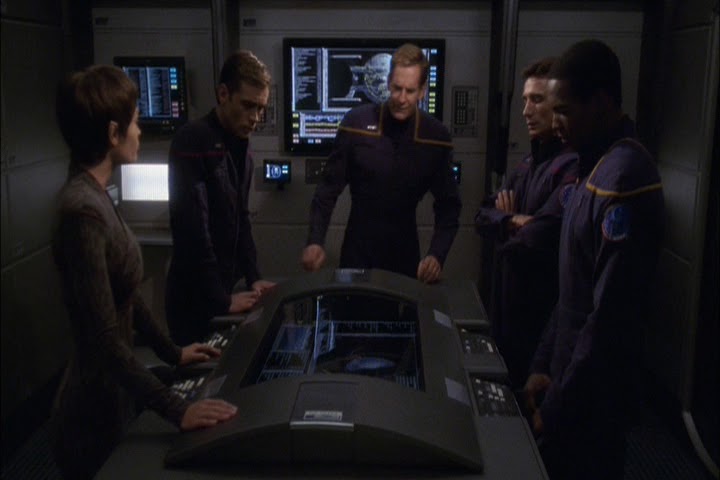
Captain Jonathan Archer (Scott Bakula) and his Chief Engineer Trip Tucker (Conner Trinneer) return to Earth after the Xindi crisis and face potentially catastrophic events on Vulcan with Science Officer T’Pol (Jolene Blalock). Lieutenant Reed (Dominic Keating) must face friends from his Starfleet past while Doctor Phlox (John Billingsly) encounters disturbing xenophobic attitudes. Can Earth work with its Vulcan and Andorian neighbors in galactic alliance– or will humanity’s short sightedness upset an already delicate interstellar balance?


“Storm Front” and “Storm Front Part II” aren’t bad episodes in themselves to open Year 4, but the ‘Alien Nazis in New York!  Who’ll stop them? The mob!’ absurdity was the worst possible cop out to resolve the Season 3 cliffhanger.  New show runner Manny Coto somehow resolves this dilemma and puts an end to the dumb Temporal Cold War, but the beginning and end of this final season feels like a big F U from departing producers Rick Berman and Brannon Braga. I get that they were trying to wrap up all of Trekdom in “These Are The Voyages…” but it was really unnecessary and a total waste of all things Enterprise – honestly, to resolve an entire series by putting it inside a crappy TNG afterthought? It doesn’t do guests Marina Sirtis and Jonathan Frakes any favors by having them repeat their characters’ younger selves, and Jeffrey Combs’ fate as the Andorian Shran is unfortunately cheapened. Ultimately, it feels as if the series’ own finale does everything it possibly can to disown Enterprise. After the majority of magic that is Season 4, the finale’s treatment is a gross, grievous mistake.


Fortunately, with Coto at its helm, Enterprise fulfils its prequel promises by returning to themes from the original Star Trek. “Home” is a much better resolution to the previous season’s consequences and Xindi plots before Brent Spiner’s guest arc and allusions to Khan in “Borderland,” “Cold Station 12,” and “The Augments.” The younger actors playing the Augments are a bit tacky, granted, but the intensity is well paced across these episodes, with solid peril to conclude each hour.  Jolene Blalock also has some serious revelations as T’Pol, and anyone who disagreed with the decidedly pissy and emotional Vulcans on Enterprise will be pleased to see “The Forge,” “Awakening,” and “Kir’Shara.” At last we get to see the planet, the people, and the problems resolved with great Vulcan connections and a restoration of TOS ideals thanks to more fine guests like Joanna Cassidy (Blade Runner) as T’Less, Gary Graham (Alien Nation) as Soval, and Kara Zediker (24) as T’Pau.  Year 4 is brighter and more colorful, too – Enterprise looks more like the original Star Trek thanks to Orions, Tellarites, and a tongue in cheek Klingon resolution with “Affliction” and “Divergence.” 


“Daedalus” and “Observer Effect” should work, but these one off filler shows fall a bit flat or feel like left over stock scripts. I don’t know why Enterprise was not envisioned as a limited series with different 22nd century themes each year.  What’s wrong with making a retro SF show? Enterprise could have taken full advantage of the excellent “In a Mirror, Darkly” two parter and been a Mirror TOS set or a companion TOS era series all along. Why not have a 6 or 8 episode mirror mini series? In a smaller season devoid of bottle shows and hip clichés, these bright colors and period sci-fi gadgets would have been dynamite! The Andorian plots in “Babel,” “United,” and “The Aenar” add a hint of unseen Romulan interference as well, and the two part “Demons” and “Terra Prime” have humans shaking off our last prejudices for alien alliance and the seeds of the Federation. Simply put, Enterprise deserved to continue on these topics. There was certainly potential for more founding of the Federation themes and Romulan plots, and the series was not a washed up waste as so many were led to believe thanks to the earlier seasons’ unrealized promise under Berman and Braga.  In the end, I think Enterprise simply came at the wrong time – caught between Voyager fatigue and a transitioning television era. The original producers wanted to stick with the old, tried and true formula but a fresh, punchy homage perspective was needed to take this last spinoff to the next level.  Those unhappy with the current Trek film incarnation’s youthful hipness can return here, and I definitely recommend original series Star Trek fans take in this Fourth, final, finest season.
 

17 May 2013

Enterprise Season 3


Enterprise Season 3 A Pleasant Season Long Arc 
By Kristin Battestella


After the stinky that is Enterprise Season 2, the Star Trek spinoff took a new, darker direction with a yearlong storyline arc for Season 3.  While some of this lengthy puzzle and its over-reaching development are uneven, overall, this involved attempt is a strong, pleasing turn for the series.


After Earth is attacked by a mysterious alien race known as the Xindi, Captain Jonathan Archer (Scott Bakula) takes Starfleet’s first Warp 5 vessel the NX-01 Enterprise into a perilous region of space known as The Expanse. Despite warnings from Science Officer T’Pol (Jolene Blalock) and the Vulcan High Command, the vengeful Archer and Chief Engineer Trip Tucker (Connor Trinneer) intend to find the Xindi home world and destroy their next deadly weapon before it reaches Earth. Lieutenant Malcolm Reed (Dominic Keating), however, struggles with the new MACO military contingent aboard Enterprise as the crew makes ready to face an enemy out to destroy all of humanity. 


The continuing arc and onscreen mission gets off to a great start with “The Xindi,” and “Anomaly” establishes the dangers of The Expanse piece by piece with stepped up effects and weird but good-looking visuals. Subtle filming changes, upside down camera work, and flipped photography angles add to the intense music, faster angst, and all around intensity of episodes like “Twilight.” Yes, this one is a stand-alone reset amid a yearlong telling, but it is a quite awesomely acted, paced, and executed tale. “Similitude” is also heavy for Connor Trinneer as Trip Tucker, and Enterprise should have continued further on this drastic possibility rather than squeeze in more undercooking for Anthony Montgomery as Travis Mayweather and ho hum for Linda Park as Hoshi Sato. The serious science fiction and morally iffy Xindi torture in “Stratagem” is something we haven’t seen on Star Trek in some time – if at all – and this ambiguity is an excellent change onscreen and off. I wish more attention was given to all the MACOs beyond semi regular Steven Culp (Desperate Housewives, JAG) as Major Hayes, but “Harbinger” packs in three multi layered plots – and most of it is very, very good thanks to new writer Manny Coto (24, Dexter). I could do without the T’Pol TnA spectacle and forced neuro-pressure kinky taking over, but the Trip/T’Pol relationship speculations are integral to the fun, what if paradox of “E2.”  “North Star” – an excellent looking western – and the time traveling “Carpenter Street” also depart on the Xindi arc with some lightheartedness whilst still giving critical, well done hints. 


John Billingsley as Doctor Phlox adds to the pleasant scares and paranoia in “Doctors Orders” as well. Although we’ve seen this type of isolation on Voyager before, the fine acting and visual trickery layer among the pieces of the Xindi puzzle, as the Sphere Builders and spatial anomalies are slowly and carefully explained throughout the season.  Parts of “Extinction” and “Rajiin” are clunky, uneven, and spread too thin at the beginning of the season. However, pieces of the overall arc are hinted upon in seemingly stand-alone episodes like “Impulse” and “Exile” before the solid pain, death, and loss for Archer, Trip, T’Pol, and oft-Trek guest Randy Oglesby as the Xindi leader Degra in “Azati Prime,” “Damage,” and “The Forgotten.” The Xindi plots come together nicely despite the usual space faring zealots in “Chosen Realm” and gone nutty of “The Hatchery,” and heavy topics like Archer’s stealing, alien deceptions, and T’Pol’s addictions linger thru the season.  These unTrek ideals might be a grasp at ratings just as much as character development, but “The Council,” “Countdown,” and “Zero Hour” do damn fining in pulling out all the stops for a great Third Season finale.Unfortunately, Year 3’s cliffhanger to Season 4 somehow ends up as a Nazi cliché and pulls the rug out from under this mostly darn good season.  Show runners Rick Berman and Brannon Braga should have left the reins to Manny Coto much sooner, indeed.


It feels like this has been a short Enterprise review, but I don’t want to give away all the Xindi secrets! Already reduced to 24 episodes, this season might have been tauter and trouble free if there had been even less shows, as the uneven pacing and seemingly unimportant episodes are still needed to fill the episode order with cheaper bottle shows. Yes, some traditional Star Trek fans may dislike this atypical, continuous plot, but truly, Enterprise should have been this way all along. This is thee dark, 21st century way to do Star Trek on TV, serialized and with something massive at stake. Had there been ongoing plots and can’t miss suspense since day one, Enterprise might have retained audiences from week to week and saved itself from the abysmal tune outs of Year 2. Lengthy storylines and scenarios were the height of Deep Space Nine, but Enterprise wasted too much time continuing the reverse exploration of the reverse ho hum of Voyager and fell flat and unfulfilled in its predecessor’s wake. After 14 years of lowered expectations thanks to DS9 and Voyager, why should anyone give another 4 years of Enterprise a chance?   

Despite ups and downs in Season 1 and the stinky of Season 2, the Voyager burn out was too fresh in audiences’ minds to put up with Enterprise – even when it got darn good here. I’ve praised Enterprise’s final season before, but new Trek viewers or returning SF fans can begin with Season 3, move on to the solid mini arcs of Year 4, and then return to the first two seasons. Now in retrospect, new audiences are discovering the two seasons plus of solid good on Enterprise actually weren’t that bad at all. Who knew?
  

07 May 2013

Enterprise Season 2


Enterprise Season 2 is the Low Point of the Series 
By Kristin Battestella


Understandably, Enterprise had growing pains relating to its prequel approach in its debut season.  However, after a lot of promise in its first year, the second season of the last Star Trek spin off sinks to new lows and most likely put the final nail in the series’ coffin- two years in advance.

Captain Jonathan Archer (Scott Bakula), his Chief Engineer Trip Tucker (Connor Trinneer), and Vulcan Science Officer T’Pol (Jolene Blalock) battle familiar enemies and unseen foes as the NX-01 Enterprise – Starfleet’s first Warp 5 vessel – continues its exploration of nearby star systems.  Past transgressions, galactic intrigue, and pre-industrial first contact mistakes also make life difficult for Doctor Phlox (John Billingsley) and Lieutenant Malcolm Reed (Dominic Keating) as Enterprise is used in Temporal Cold War tricks and betrayals – which eventually create devastating consequences for Earth.


The “Shockwave Part 2” cliffhanger resolution starts Enterprise’s Year 2 off great. The offbeat “Carbon Creek,” hints of Romulan tensions in “Minefield,” and a touch of spooky in “Dead Stop” all build solid Star Trek mood and science fiction atmosphere. These are unique episodes with prequel pieces that no other Trek series could have done, and each has the viewer returning week after week.  “The Seventh” is a worthy T’Pol espionage adventure, and “The Communicator” shows Trek audiences how pre-industrial contact can go horribly awry. Now that we know the crew a little better, it’s also fun to see them go nutty in “Singularity” or camp out in “The Catwalk.”  Jeffrey Combs returns as the Andorian Shran in “Cease Fire,” and “Future Tense” is a strong time episode that remains smartly TOS instead of Temporal Cold War. “The Breach” also has some excellent science fiction debates between Archer and Dr. Phlox, and these shows are a great example of how Enterprise should always be. This crew toes the no Prime Directive line, and sometimes the humans are the jerks of the budding galactic community, yes. They often get into trouble by helping or not helping alien friends and neighbors. Unlike some previous episodic Trek that kept things nice, easy, and tidy, however, consequences can linger on Enterprise, and “Cogenitor” is an awesome example of SF mistakes and misunderstandings that cannot be taken back.

Thus far, it sounds like Enterprise’s second season is nothing but glory, I know.  Unfortunately, a batch of bad episodes sent the show’s viewership into a tailspin from which it never recovered.  After the notoriously Freudian forced “A Night in Sickbay,” Enterprise drove itself further down with the rehashedly bad “Precious Cargo” and the typical save the frontier town “Marauders.” “Vanishing Point” might not be a bad show in and of itself, but the Hoshi Sato (Linda Park) dreamt it all crux is enough to anger audiences into never watching again. Likewise, “Dawn” is a complete Enemy Mine joke, and the serious episodes can’t gain any momentum thanks to unacceptable clunkers like this. Although “The Crossing” and “Horizon” are hokey and “Stigma” is obvious in its AIDS allegory, it’s tough to take even the half decent amid so much bad.  “Canamar,” “Judgment,” and “Bounty” also suffer from statistical retreads, for how many times can Archer be abducted or kidnapped, hijacked or imprisoned, or taken hostage and committed in one season? We seen the nods to Star Trek VI, love the Klingons, Tellarites, and faux pon farr. Sadly, these are all plots we’ve seen too much already, and its all the more infuriating here because Enterprise should be doing so much more with its pre-Kirk designs.


“Regeneration” encapsulates this very conundrum. On its own, this is a fine episode, complete with superb X-Files spooky and scares, action plotting, and big consequences. Were this simply a rogue horror episode, no one would object to its appearance on Enterprise. Unfortunately, longtime Trek viewers will groan at the officially unofficial appearance of the Borg, 24th century tech babble, and the Delta Quadrant paradoxes created here. Is it a good show? Yes. Does it belong on Enterprise? No. “First Flight,” by contrast, shows us Archer’s motivations in the early Warp program and provides a lovely guest performance by Keith Carradine.  This bumbling San Fran base and competitive space race storyline makes one wonder why Enterprise didn’t begin its first season on Earth pre-launch as the producers momentarily envisaged. If you’re not going to give us the Romulan War and the founding of the Federation, why not begin the beguine? Likewise, “The Expanse” season finale feels cramped and time compressed in its rush to return to Earth despite a sweetness to its bittersweet. Why couldn’t they have traded all those clunker episodes for a few more ending hours of a ship in mourning? Perhaps then spending too much time on Earth under an alien attack was too close to 9/11 memories, but it would have certainly made for some fine SF drama.    


I’ve focused more on episodes in this Year 2 analysis than characters as usual simply because the likeable players on Enterprise are not the problem.  Well, Anthony Montgomery as pilot Travis Mayweather somehow has even less to do then he did before, but otherwise, this cast is vastly superior to Voyager’s ensemble bane. Despite some fine episodes and developments both good and bad for Archer, Trip, and T’Pol, I sincerely think that if this season had been skipped in its entirety, Enterprise might have continued beyond its four years.  No cheap gimmicks, sex jokes, or humorless thrills were spared in the dragging the bad sci-fi thru the mud here.  And what makes this all really sad is that we got this instead of all the aforementioned Federation and Romulan rumblings. With those dynamite plots – the ones most Star Trek audiences had been waiting for since the moment a prequel was mentioned – who knows what glories Star Trek might still be having on television today.  Alas, Enterprise was on borrowed time once viewers turned away from this shoddy season. 

 There is quality in Season 2 of Enterprise, yes.  However, I wax nostalgic on the possibilities of what this series could have been because this sophomore year served up such infamous crap. Only die-hard loyalists can enjoy this season, and that’s with skipping half the shows. I love Enterprise, I really do. The realistic players and 22nd century opportunities do indeed come in Seasons 3 and 4, so do hang on with Enterprise despite the Year 2 iffy. Please?
 

15 April 2013

Enterprise Season 1


Enterprise Season 1 Shows Promise
By Kristin Battestella
 

More than a decade after its 2001 debut, I still feel as though the last Star Trek television spinoff Enterprise is somewhat unloved. Despite its relatively short for modern Trek four seasons and plenty of pressure thanks to timeline continuity and fan expectations, this first season provides a lot of potential, solid core players, and room to maneuver in an untapped area of Trekdom.

Captain Jonathan Archer (Scott Bakula) and his Chief Engineer Charles ‘Trip’ Tucker III (Connor Trinneer) are reluctant to have the Vulcan Science Officer T’Pol (Jolene Blalock) assigned to Starfleet’s first Warp 5 vessel, the NX-01 Enterprise.  It’s been a hundred years since First Contact, but Archer believes the Vulcans have held back Earth’s warp development. When an injured Klingon crash lands in Oklahoma, Starfleet is forced into further politics both past and present. Archer fills out his crew with a Denobulan Doctor Phlox (John Billingsley) from the Interspecies Medical Exchange, a British Armory officer Malcolm Reed (Dominic Keating), a space boomer pilot Travis Mayweather (Anthony Montgomery), and linguist Hoshi Sato (Linda Park) as Enterprise launches into its first intergalactic adventures where they encounter friends and foes both familiar and unknown.


Enterprise is a little uneven to start, which is understandable for a series trying to attract new audiences whilst also toeing the line of past Trek lore. Poor science, bumbling dialogue and mistakes, and retreads of Star Trek staples that the core fans will already know, however, are tiresome – as in the introduction to Klingons in “Sleeping Dogs.” “Strange New World” also comes to early in the season for people we just met to get their alien crazy on, and “Unexpected” can’t decide if it is boldly going where no man has gone before in a serious science fiction examination or as premature comic relief.  “Civilization” does much better in placing our crew in a pre-industrial costumed escapade, but “Terra Nova” already feels like a Voyager rehash with hokey dialogue and unrealized values. “Oasis” also resorts to near 24th century hologram uses and a guest appearance by Deep Space Nine star Rene Auberjonois just a little too soon. Likewise, alums Clint Howard, Ethan Phillips, and Jeffrey Combs make technical appearances as Ferengi in “Acquisition.” Sometimes it’s as if longtime Trek showrunners Rick Berman and Brannon Braga can’t or won’t let Enterprise spread its wings without these precursor training wheels and ham fisted sex and humor attempts ala “Two Days and Two Nights” getting in the way.

With the exceptional Vulcan, Human, and Andorian relations in “The Andorian Incident” and “Shadows of P’Jem” – Combs is wonderful as the Andorian Commander Shran – there is no need for such rocky reliances on 24th century easy. Ironically, any internal flaws on Enterprise are quite refreshing. So, people one hundred years from now aren’t as badass as Kirk or so put together as The Next Generation, who knew? These humans mess up in galactic relations, are fearful of new technology, they watch movies, and make civilization altering mistakes thanks to the lack of the future Federation’s Prime Directive. Archer even has a beagle named Porthos on the ship! While we love The Original Series for its groundbreaking idealism and applaud TNG for its often seriously mature sci-fi retellings, Enterprise is, well, normal. We can relate to a crew that doesn’t exactly know what its doing and isn’t so far removed from us in so many ways. The season premiere “Broken Bow” establishes where we are in the journey, and  early transporter touches and nods towards developing future technology like force fields are quite fun to see. Yes, the jizzy white slime everywhere in “Vox Sola” is hokey. However, there is also a lot of Star Trek charm in this show’s design. Each of the crew pairs off for a unique alien problem-solving dilemma, and “Dear Doctor” provides plenty of ethical debates and needs for space faring delicacy. 


Don’t lie, I’m sure there were a boatload of Quantum Leap fans who tuned into Enterprise just to see Scott Bakula again, and his long time Al pal Dean Stockwell also takes it to Jonathan Archer in “Detained.” We like Bakula, so by default we like Archer, even if he isn’t always as suave as Kirk or perfect as Picard. Sometimes, he’s even a bit of an ass with his Vulcan resentment and naïve explorer perspective, but Archer tells it like it is and is ultimately trying to do what is best for his ship, crew, and Earth.  Fans of Connor Trinneer’s (Stargate Atlantis) Trip Trucker also have plenty of opportunities to see him in his Starfleet undies, which both works in some episodes and yet gets old quick.  Despite this underlining push at some bizarre unresolved sexual tension, the dynamics between Trip, Archer, and T’Pol are nicely done.  Archer ways the pros and cons from each, and there is a bemusing banter and healthy antagonism as need be, particularly in “Desert Crossing” – although “Rogue Planet” is an alien iffy attempt to give Archer some chick action. Playing an emotionless alien is never easy, but Jolene Blalock (Jason and the Argonauts) does well as T’Pol.  We can’t quite compare this female addition to prior onscreen Vulcans and the catsuit forced sex appeal is apparent, granted. Yet T’Pol’s unconventional ethics and multi dimensional Vulcan histories and experiences in “Fallen Hero” and “Fusion” are solid SF tales.

Enterprise mirrors TOS with its main triumvirate, but Dominic Keating (Heroes) as Malcolm Reed and John Billingsley (True Blood) as Doctor Phlox create a strong secondary presence.  Where everyone is mostly happy to be tripping the life galactic on prior Trek ships, Reed is an often uncomfortable crew member with fine technical expertise as seen in “Silent Enemy.” There are times when his utilization as security chief is grossly underwritten by the powers that be, however – although this lack of military preparedness often becomes a critical plot point, as in “Cold Front.” Audiences will scream at the television that security should always be present when meeting alien guests or going on strange away missions, but thanks to Reed, the development behind these protocols is also an interesting dimension on Enterprise. Indeed, their exploratory mission is not going to be as friendly as they had hoped, and we get to see a lovely friendship develop between the contrasting Reed and Tucker in “Shuttlepod One.”  Likewise, Phlox provides humor in “Two Days and Two Nights,” wisdom in “Fight or Flight” and even antagonism in “Vox Sola.” I wish they had made the character a not often seen previous species rather than a new Denobulan, but Phlox is a delight because we don’t quite know what nugget or wrench he will contribute each episode. Together, Reed and Phlox both provide alternate pros and cons to the Big Three of Archer, Trip, and T’Pol.  Phlox doesn’t always get along with Archer, but as Enterprise’s resident aliens, he and T’Pol develop a kinship.  I myself like the awkward suggestions between the somewhat geeky Reed and the svelte T’Pol.  After so many years of a lack of character development on Voyager, these cast elements are well done.


Unfortunately, I cannot say the same about Anthony Montgomery (Popular) as the boomer pilot Travis Mayweather and Linda Park (Crash) as linguist Hoshi Sato.  I love the idea of their being obstinate, archaic space privateers hating the fast, new Starfleet, and I love the idea of an unreliable universal translator and the need for realistic communication buffers with new alien species. Sadly, neither of these potential intriguing plots works because these roles anchoring them are absolutely lethargic, and it is ridiculous that the minority players end up so under developed and clichéd. Simply put, Mayweather and Sato should not have been regular characters in Season 1. Always screaming and squeamish Hoshi has the simplest, most obvious analogies possible, and it took my husband 10 episodes to realize that the blank, always-staring forward helmsman was even there. Ouch! The Next Generation got by with not always having significant ship personnel positions as main cast members. If Enterprise was knowingly pursuing a TOS Big 3 format with strong alternating Scotty styled support, then these translator and pilot roles should have been semi regular as needed. Outside of the weak spotlight episodes “Fortunate Son,” “Breaking the Ice,” and “Fight or Flight,” these characters aren’t that significant, and their short end of the stick inclusion takes away from far more interesting early Starfleet dilemmas and brewing alien politics. I mean, they are junior officers but senior staff? Enterprise should have built its foundation first, and then once we were secure in where the show was going, these lower decks developments could have come later.

Of course, part of Enterprises problem is that, like Voyager and Deep Space Nine, the series spends half its time deciding what it wants to be. All the positive characters and unique time and place potential that is going for Enterprise and yet the bane of the show will end up being this stupid Temporal Cold War storyline. Begun in “Broken Bow” and then shoddily treated until “Cold Front” and then the season finale “Shockwave,” this dumb time travel crutch on top of all the other beforehand future after the fact Trek franchise helps and hindrances is exactly the wrong way to start your prequel series.  What the hell kind of fail-safe future connection are the producers trying to pull? I am not a wholehearted fan of the new Star Trek reboot, but I applaud its intelligent way to both canonly sanction and keep their alternate universe adventures. It seems the writers had no such forethoughts with the Temporal Cold War on Enterprise, and had they tossed this plot, I seriously think Enterprise would have gone on to additional seasons and further success with no franchise film reboot required.


Despite newer, grandiose Trek designs and CGI wizardry this decade, the special effects, make up, and dressings on Enterprise still look great.  Some familiar with 24th century Star Trek looks may complain that Enterprise is still too futuristic in design, but the darker, submarine style lightning and sets are indicative of this middle space flight era. The uniforms – complete with away jackets, NX-01 hats, sunglasses, and desert get ups – are also a lot of fun and much more in keeping with our current astronaut jumpsuits and patchwork. Some of the futuristic casual clothes, however, are bemusing. The design of the opening credits, on the other hand, is dynamite.  Seeing the Enterprise premiere the first week after 9/11, I choked up at the montage of exploration, aviation, space aspirations, and human ingenuity. Although Enterprise would later struggle to find its brand of Trek positives in a contemporary world so grim, the one strike against the series that automatically dates its presentation is that friggin’ ass theme song.  Science fiction demands a certain universally symphonic score, a sweeping standard theme.  While the instrumentals and old Trek sounds on Enterprise are just right, the lyrics to the “Faith of the Heart” intro are so, so nineties wrong.  Have you ever known a science fiction show to have a lyrical pop song like this as its theme? Of course not, but I’ll be fair. Even if you like the tune, it simply does not belong as the anchor of a dramatic genre pursuit, much less a Star Trek series.

The use of this “Faith of the Heart” theme is indicative of everything that was wrong with Enterpriseall its forced need to be hip, new, edgy, not your papa’s Trek. For those who were hoping to get back to quality Star Trek after the disappointment that was Voyager, this insult has the exact opposite effect and ultimately, there were many viewers who wrote off Enterprise solely because of that stupid song. If you let go of the Decon Chamber undressings and sexy attempts, forgive the underdeveloped side plots and lesser players, and get over the Temporal Cold War, there is a damn lot of good brewing on Enterprise.  Fans who burned out on Voyager or disagreed with Deep Space Nine can return here. Those growing tired of the same desperate for youth in your face of the reboot can also find some SF maturity on Enterprise, and non-Trek audiences may like its new, honest precursor approach.  With streaming options and affordable DVDs with plenty of features and extras, there’s no reason for sci-fi viewers to not give Enterprise a chance.


04 October 2010

Fall Suspense and Thrillers

-->
Autumn Suspense and Thrillers
By Kristin Battestella

What better way is there to spend a stormy autumn evening then with some cool mystery, heady suspense, classic thrillers, or spy hijinks? 


The Asphalt JungleThe Asphalt Jungle – John Huston’s (The Maltese Falcon, The Treasure of the Sierra Madre) brooding 1950 noir starts slow, but the wonderful cast twists and turns this complex, intricate heist tale into a grand, sharp tongued classic.  Sterling Hayden (Johnny Guitar, Dr. Strangelove), Supporting Oscar nominee Sam Jaffe (Gunga Din, Ben Hur), and a budding, forties styled innocent but no less femme Marilyn Monroe (Some Like it Hot) lead the viewer on the murderous city scene as the dark, intricate lives and crimes blur together into one tragedy and double cross after another.  The ensemble is exceptional, everyone’s corrupt, you can’t trust anyone, and it makes for damn fine film.

Color of Night – Yes, the uncensored glimpse of Bruce Willis’ (Die Hard, Moonlighting) wang brought a lot of negative attention to director Richard Rush’s (The Stunt Man) 1994 thriller.  The psychological run around and build up of hints, however, outshines the kinky drivel and the more obvious plot points here.  The poor editing and numerous chopped up editions hurt this mystery more than anything else did, but not all the steamy nineties erotic scenes have stood the test of time either. Thankfully, the ensemble cast- including Leslie Ann Warren (Clue), Scott Bakula (Quantum Leap), Brad Dourif (Lord of the Rings), and Lance Henriksen (The Terminator) is very good-especially when plot holes and weak dialogue fails them.  There’s not a lot of repeat value once you’ve figured this one out but it’s a lot of fun guessing the twists or shouting at the inconsistencies on that first viewing. Although there’s yet to be a definitive DVD edition, give this one a chance.

Red Riding TrilogyRed Riding: 1974, 1980, 1983 – Directors Julian Jarrold (Brideshead Revisited), James Marsh (Man on Wire), and Anand Tucker (Shopgirl) have crafted an exceptional trilogy based on the novels by David Peace and adapted by Tony Grisoni (Fear and Loathing in Las Vegas).  This morbid tale based on real life events captures the scope of corruption, gruesome violence, depression, and emotions.  Each film can be viewed separately, but this is indeed a trilogy with all three completing a much larger puzzle. The varying styles, great period music, and Yorkshire brooding are wonderfully filmed. Performances by Andrew Garfield (The Social Network) Sean Bean (Sharpe), Paddy Considine (Hot Fuzz), Mark Addy (The Full Monty), David Morrissey (Blackpool) and the rest of the ensemble are exceptional.  We follow each of our protagonists even though they can’t possibly surface in these disturbing waters much less win out.  This series is not for the faint of heart, and subtitles are required thanks to plenty of whispers and soft sounds. Although Red Riding is a very heavy series, depressing, and confusing in some spots, Americans should definitely see this fine multi layered piece twice if you can stand it.  Law and Order: Special Victims Unit wishes it could get away with this kind of disturbing magic.  Hollywood simply does not know how to make this kind of film, and I can’t imagine Ridley Scott attempting to top this wonderful piece with a big screen remake. Please don’t bother! This may be the best recent series on either side of the pond-I haven’t looked forward to an ending and jumped up and down for it this much since Trainspotting.

The 39 Steps (2008) – No, this is not the Hitchcock classic, but I don’t know why this recent adaptation starring a Cary Grant-esque Rupert Penry-Jones (MI-5) and lovely Lydia Leonard (Jericho) gets no love.  Director James Hawes (Doctor Who) takes some historical liberties, absolutely, but the period music and World War I styles add to the Scottish action and locales.  An American version would have Hannay and the hottest 18 year olds updated to today with terrorism in L.A., oil mania, and more transportation chases then you can shake a stick at.  Though silly, fun, and too fast in some places, the mystery and chemistry keep this one entertaining from beginning to end.  I could have done without Penry-Jones’ super bleachy blonde hair, but the period espionage action here makes me again wish that the Bond reboot had been period as well. And why not continue the good here in another Hannay telefilm?

Touch of Evil – Orson Welles’ 1958 noir classic has its fair share of cinema history and infamy.  Unprecedented tracking shots and Charlton Heston (The Ten Commandments, Ben-Hur) as a Mexican-what the heck is going on here?  A damn fine, complex thriller that’s what.  Naturally, the editing and pacing suffers from all the studio interference and recuts, but Welles’ (Citizen Kane) corrupt Captain Quinlan and the ambiguous mistreatment of Janet Leigh (Psycho) keeps the suspense wonderfully seedy.  Oscar winner Henry Mancini’s (Breakfast at Tiffany’s, The Pink Panther) music also ups the onscreen ante.  All this heady crime and its Marlene Dietrich (Morocco, Witness for the Prosecution) who almost steals the show along with a creepy Mercedes McCambridge (All the Kings Men).  I could do without all the aforementioned Mexican stereotypes, but the 112 minute restored version honoring Welles’ original vision is worth another look.

The Usual Suspects (Special Editon)The Usual Suspects – I suppose now everyone knows how this 1995 thriller directed by Bryan Singer (X-Men) and starring Oscar winner Kevin Spacey (American Beauty, L.A. Confidential) ends.  Yes, repeated viewings may pick up a few flaws, but if you haven’t seen this one in awhile, give it a second look with fresh, intelligent eyes.  Better yet, if you can find a viewing virgin who doesn’t know the end thanks to all the spoofs or parodies- make the popcorn and turn out the lights.

18 March 2009

Quantum Leap: Seasons 4 and 5

Seasons 4 and 5 Branch Out, Almost Undo Quantum Leap
By Kristin Battestella

Yes, after all my Quantum Leap praise, I do realize that the spiritual turn taken in Seasons 4 and 5 of the moral science fiction show is probably what turned off viewers and led to the series’ cancellation in 1993. That being said, Donald P. Bellasario’s award winning series still provides great statements and thinking man’s television in its final two seasons.

Quantum Leap - The Complete Fourth SeasonSeason 4 of Quantum Leap opens with a little something we all wanted to see. ‘The Leap Back’ returns Sam to his own time, where we discover the wife he has forgotten amid his travels. Equally challenging is the finale ‘A Leap for Lisa’ where Sam leaps into a young Al on trial. Unfortunately, much of season 4 in between feels like filler we’ve seen before- like ‘Justice’, dealing with the Civil Rights movement and the Klu Klux Klan; and ‘Raped’- where Sam leaps into an assaulted teenager. Only the exceptional ‘Running For Honor’ stands out-an episode where Sam leaps into a gay Naval cadet. Maybe gay issues on television are commonplace now, but it was unheard of then.

Season 5 continues some of the lackluster trend, with stunt episodes focusing on Lee Harvey Oswald, Elvis Presley, and Marilyn Monroe. Unique to this season, however, are the Trilogy episodes-where Sam leaps into subsequent generations of one Southern family and the two part ‘Evil Leaper’ episodes. Sam also leaps beyond his lifetime into a Civil War ancestor for ‘The Leap Between The States’. Some of these twists stray too far beyond the series’ own believability, yet others are intriguing additions to the Leap premise. Had the series continued into a sixth season, we have the possibility of more Leapers- both good and bad-and explanations behind the science and religion of time travel.

Even though Quantum Leap is science fiction for folks who don’t like science fiction, the lovely spiritual statements introduced in these two seasons are generally considered to be the final nail in the show’s coffin after 5 years of great television. The cast and crew continued to make strong, episodes with moral conviction; but after so much sentimentality, it’s not Quantum Leap’s fault that an increasingly amoral, grunge listening, conspiracy theory loving audience tuned out. With the exception of some stunt casting and the blatantly big name storylines, Quantum Leap perhaps brings its strongest statement with its Evil Leaper and Godly notions. Who is moving Sam through his leaps? If he is sent to do good, surely there is a balancing force seeking evil at work. Perhaps in 1993, these ideas were too close to home for audiences; but such notions only grow better with age when applied in our own lives. Who moves us from one day to the next? Why do things happen as they do? Is there no such thing as coincidences? Are there people placed on this earth purely for evil? Am I the one placed here to do some good in this world?

Scott Bakula and Dean Stockwell shine again in both the stellar and the not so stellar episodes here. Stockwell takes Al through the emotional ringer, even leaping himself a time or two while facing his own past. Bakula brings all the range needed as well-from singing as Elvis to talking sex as Dr. Ruth. Though it is somewhat of a stunt, having our boys switch places shows the award winning talent between Bakula and Stockwell. Sam and Al have entered our cultural lexicon; and from the first day Bakula appeared as Captain Archer on Star Trek: Enterprise, talk of reuniting with Stockwell brewed. Quantum Leap fans got their wish in Enterprise’s Season 1 episode Detained.

Quantum Leap - The Complete Fifth SeasonOf course, I cannot praise Quantum Leap without commenting on the series’ finale ‘Mirror Image’. I love it, but I also hate it. The conclusion is fitting to the series, but also leaves several critical questions up for grabs. After seeing the end to Quantum Leap, you either crave more and have to watch the series all over again; or you insist on giving the show ten years to stew and mull on before you can rewatch. Either way, Quantum Leap stays will you long after your latest viewing.

Again the dvd sets for Season 4 and 5 have been unloved with music changes, too brief extras, and unusual packaging and disc layering; but technical mistakes should not deter viewers from seeing this show for the first time or falling in love with Quantum Leap again. I’d like to think Universal will come to their senses and release a complete series set with proper extras and restoration, but I won’t hold my breath. Affordable pricing, online viewing, and rental options keep their pockets lined a plenty.

Quantum Leap is the type of show that they don’t make anymore. It says something beyond its science fiction premise and stretches far beyond its time traveling mission. Its effects and social commentaries may seem dated to some in this fast-paced day and age; but Quantum Leap leaves the candle burning on the big and small issues of the 20th century. Young and old can appreciate this series for years to come.